
Frequently Asked Questions
The questions foreign investors and owners ask us most often. Jump to a topic, or browse the full list — and if yours is not here, ask us directly.
Buying
Can foreigners buy property in Japan without residency?
Yes. There are no restrictions on real estate ownership by foreign individuals or companies, regardless of visa or residency status. A non-resident owner simply needs to appoint a Japanese tax representative (納税管理人) for ongoing filings.
What are the all-in closing costs on top of the price?
Roughly 6–8% of the purchase price: brokerage (3% + ¥60,000), judicial scrivener, stamp duty, and registration tax. Acquisition tax is billed 3–6 months later at another 1–3%. New builds add 10% consumption tax on the building portion.
Can I get a mortgage as a non-resident?
A handful of regional and specialist Japanese banks offer non-resident mortgages at 2.5–4.5% with 40–50% LTV. Most mainstream lenders require residency and Japanese income. For many foreign buyers, home-country financing secured against the Japanese asset is simpler.
How long does a typical purchase take?
4–8 weeks is typical: offer → important matters explanation → purchase agreement → settlement → registration. Cash deals can close in 3 weeks; heavy financing may extend to 8–10.
Do I need to travel to Japan to sign?
No. A notarised power of attorney lets a representative sign on your behalf. Plan on a few extra days for document couriering.
Selling
How do Japanese brokerage fees work on a sale?
The maximum legal brokerage is 3% of the sale price + ¥60,000 + consumption tax, per side. Most sellers pay this in full at settlement. The fee is negotiable in competitive listings, particularly on higher price points.
What documents do overseas owners need to sell?
Key documents: original title identification (登記識別情報), a signature certificate from your local embassy or notary (in lieu of a Japanese personal seal), residence certificate, and the purchase documents from when you bought. Your broker and scrivener will guide the exact set.
Is the sale price subject to withholding tax for non-residents?
Yes — 10.21% is withheld at settlement when the seller is a non-resident, unless the buyer is an individual buying for personal residence at a price of ¥100M or below. The withholding is creditable against your final tax bill when you file.
Renting
What is “key money” and is it refundable?
Key money (礼金) is a one-off gift to the landlord, traditionally 1–2 months of rent, and is not refundable. It is slowly disappearing in competitive rental markets but still common. Do not confuse it with the deposit (敷金), which is refundable minus cleaning and damages.
Can I rent without a Japanese guarantor?
Yes — most landlords now accept a paid guarantor company (保証会社) in place of a personal guarantor. The fee is typically 50–100% of one month’s rent upfront and an annual renewal fee.
How much does the total move-in cost?
Budget 4–6 months of rent upfront: first month’s rent, deposit (1–2 months), key money (0–2 months), brokerage (1 month), guarantor fee, fire insurance, and key exchange. Always ask for an itemised quote before signing.
Legal
What does the judicial scrivener (司法書士) actually do?
They handle the title registration and verify that the documents exchanged at settlement are in legal order. They act as a neutral professional — not an advocate for either side — and their fee (typically ¥100,000–¥300,000) is split by convention or paid by the buyer.
What is the “important matters explanation” and why does it come before signing?
The 重要事項説明 is a mandatory disclosure by a licensed real estate transaction specialist covering zoning, title history, infrastructure, and contract terms. By law it must be delivered before the purchase agreement is signed — treat it as your final due-diligence checkpoint, not a formality.
How does the 2020 civil code reform affect my used-property purchase?
The old “defect liability” was replaced with a broader “contract non-conformity” regime. Most individual-seller contracts now limit or exclude this liability — which is legal but shifts structural risk to the buyer. Always read the clause carefully and consider a pre-signing inspection.
Tax
How is rental income taxed for non-residents?
Net rental income (after depreciation, interest, repairs, and management fees) is taxed at Japan’s progressive rates (5–45% national plus 10% local). Non-residents must file annually in Japan via a tax representative. Most tax treaties allow you to credit the Japanese tax against your home-country liability.
How does the short-term vs long-term capital gains rule work?
Held ≤ 5 years on January 1 of the sale year = short-term (≈ 39.63% residents / 30.63% non-residents). Held > 5 years = long-term (≈ 20.315% / 15.315%). The clock counts to Jan 1, not the calendar day — a timing trap worth planning around.
Is Japanese inheritance tax a concern for foreign owners?
Yes. Japanese real estate is a Japan-situs asset, so Japanese inheritance tax always applies on the property itself. Whether worldwide assets are also caught depends on the residence status and timing of the owner and heirs — see the Legal & Tax guide for the matrix.
Visa
Does buying property give me any kind of visa?
No. Japan has no “investor visa” or residency-by-investment programme tied to real estate. Ownership is completely decoupled from immigration status. The closest structured path is the Business Manager visa, which requires an active, managed business — not passive rental holdings.
Can I use rental income toward a Business Manager visa application?
In principle yes, if the rental operation is structured as a genuine managed business with a physical office, staff or contractors, and documented operations. Purely passive ownership of one or two units typically does not meet the bar. Consult an immigration lawyer before structuring around this.
General
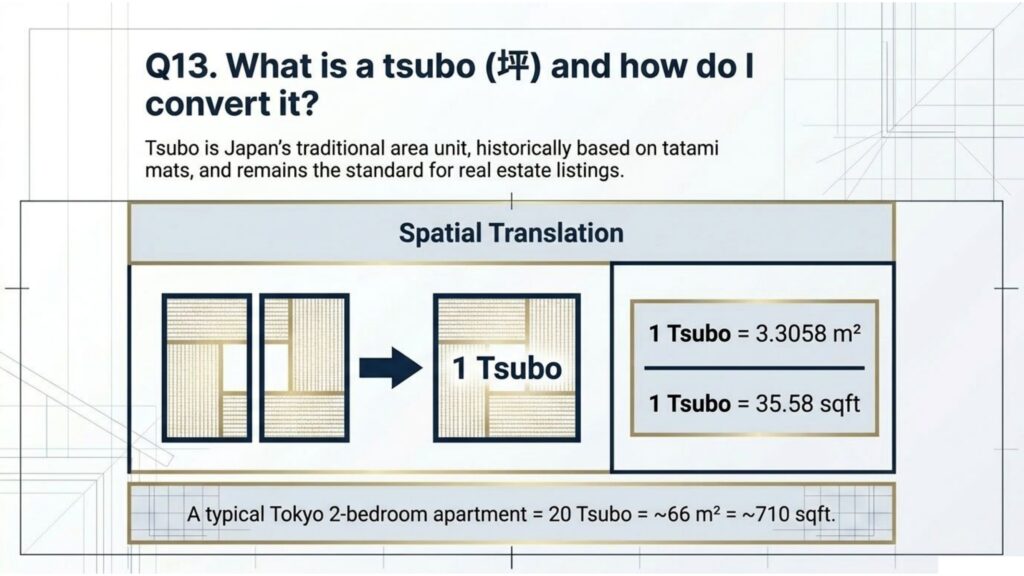
What is a “tsubo” (坪) and how do I convert it to m² or sqft?
Tsubo (坪) is Japan’s traditional area unit, still used throughout real estate listings. 1 tsubo ≈ 3.3058 m² ≈ 35.58 sqft. A 20-tsubo apartment is roughly 66 m² (710 sqft) — a typical two-bedroom Tokyo unit.
For a full explainer plus a live converter between tsubo, square metres, and square feet, see our dedicated page. Open tsubo converter →
Is Realty Japan a brokerage, a consultant, or something else?
We are both a licensed real estate brokerage and an information hub. Our consultation and proposal service is free; we earn standard brokerage fees only on transactions we introduce and only if you proceed. All fees are disclosed upfront.
Do you work with buyers outside Tokyo?
Yes. Our core network covers Tokyo, Osaka, Hokkaido (especially Niseko and Furano), and Kyoto. For other regions we partner with vetted local brokerages and coordinate on your behalf — see the Areas section of the site.
Ask us directly
Send us your specific situation — residence status, timeline, budget, and the question on your mind. A bilingual specialist replies personally within 24 hours. Free consultation, no obligation.
Submit Your Requirements →